27.02.2026
2nd Eraldatu Social Impact Encounter: A highly successful event reaffirming that purpose drives organizations
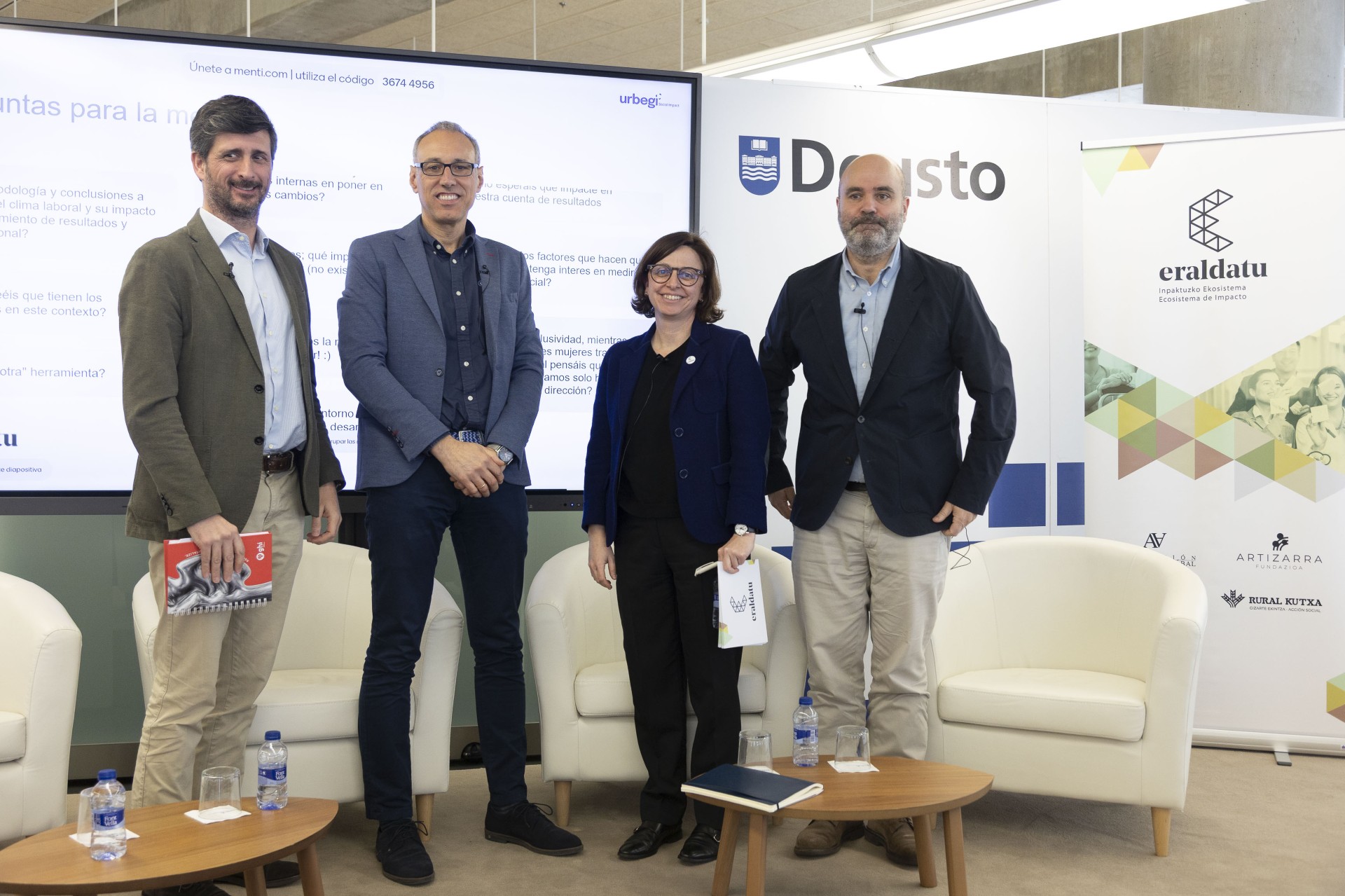
The two sessions held on February 24 in Bilbao drew a large crowd, exceeding participation expectations.
Entities, companies, and entrepreneurs who practice or are interested in gaining an understanding of impact initiatives in the CAV (Basque Autonomous Community) followed with interest the contributions from the business, university, and institutional sectors during the morning session at the CRAI of the University of Deusto.
In the afternoon, maximum capacity was also reached at the EDE Fundazioa session, which was specifically directed at third sector entities, the social economy, and foundations.
This February 24, Bilbao became the epicenter of the debate on social impact with the celebration of the II Social Impact Encounter organized by the Eraldatu ("transform") node, under the inspiring title "From Purpose to Impact: The Soul that Moves Organizations."
The conference, which took place in a double session — morning at the CRAI of the University of Deusto and afternoon at EDE Fundazioa — exceeded expected participation forecasts, bringing together a large and diverse audience composed of institutional representatives, companies, investors, third-sector entities, university students, and entrepreneurs interested in integrating social impact initiatives into their business.
From the early hours, the Center for Learning and Research Resources (CRAI) recorded a notable attendance. The welcome was given by Jokin Aranzabal, trustee of the Antonio Aranzabal Foundation, and the institutional opening was led by Ainara Basurko, Deputy for Economic Promotion of the Foral Deputation of Bizkaia, who stressed the importance of "aligning competitiveness and social commitment" in the current economic context of companies and organizations.
The first round table, "What do we mean by impact? From global vision to local commitment," brought together leading figures such as Mª Ángeles León (Open Value Foundation), Óscar Ugarte (Seed Capital Bizkaia), Juan Barbed (Rooral), and was moderated by Javier Martínez (Social Action of Rural Kutxa).
The debate allowed concepts to be materialized and demonstrated how social impact has moved from being an emerging trend to consolidating itself as a strategic axis in many organizations within the CAV.
One of the most celebrated moments was the second table, "Measuring Social Impact in Companies: The Vision of the Youth," in which students from the double degree in Business Administration (ADE) and Law at Deusto Business School shared their experience in real measurement projects. Their speech brought freshness, rigor, and a generational perspective that aroused keen interest among the attendees. Many of them were students from the Bilbao campus of the University of Deusto.
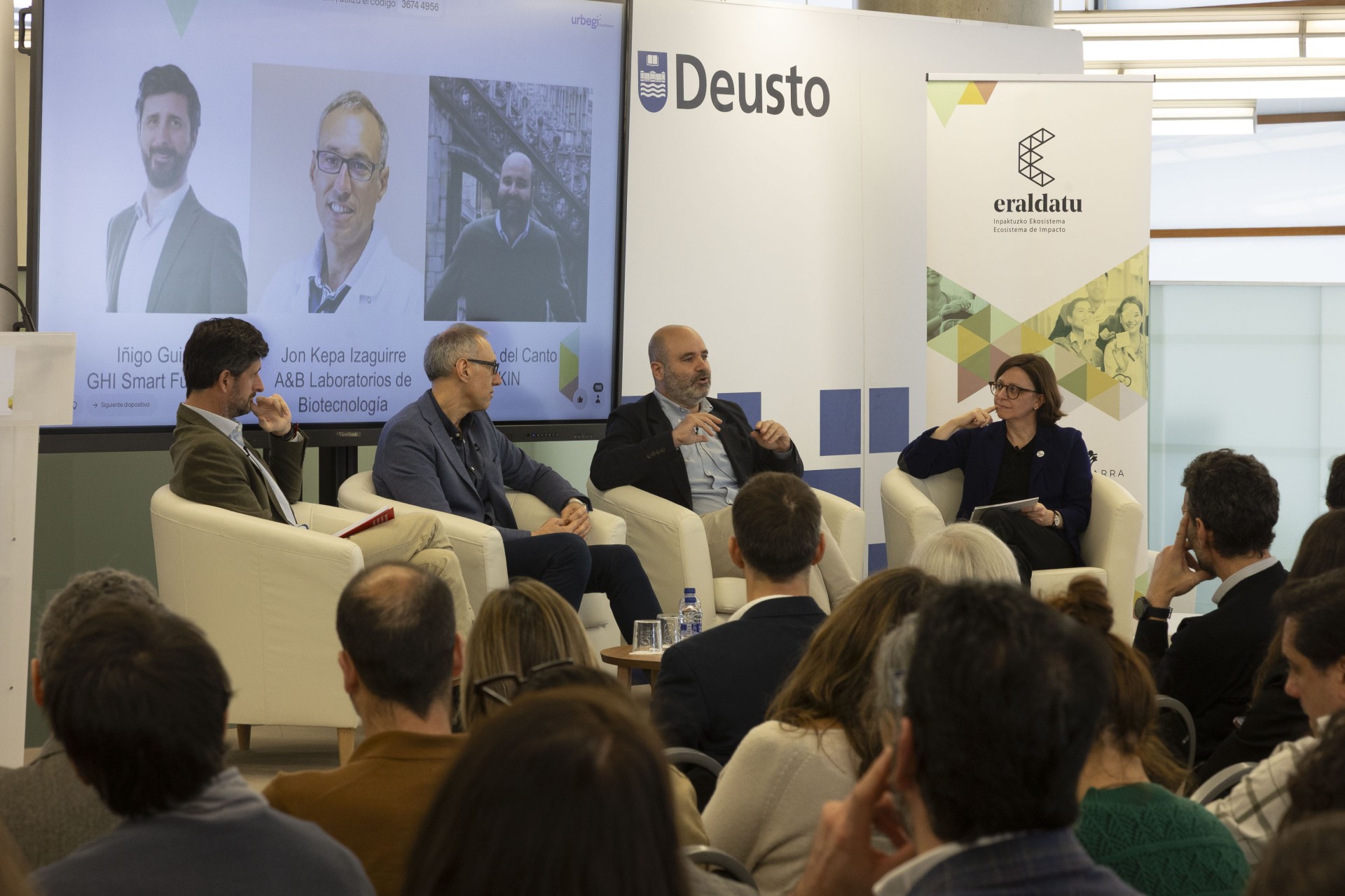
After the coffee break, which also served as a networking space to generate synergies, the third round table, "From Intention to Legacy: Keys to Measuring and Multiplying Impact," delved into tools, methodologies, and practical learnings to consolidate measurable and sustainable impact models over time.
Participating in this block were Iñigo Guinea (Guiar Group, GHI Smart Furnaces), Jon Kepa Izaguirre (A&B Laboratorios de Biotecnología), Agustín Del Canto (OKIN), and the panel was moderated by Iranzu Sainz de Murieta (Founding partner of Sinnple).
In this section, the presentation of the "Eraldatzen" (transforming) methodology promoted by Eraldatu aroused special interest. It proposes a pioneering method to be applied in companies that are not satisfied with responsible management based on ESG (Environmental, Social, and Governance) criteria, but wish to lead an internal "transformation" that benefits society.
"Eraldatzen" conceives impact as an active (measurable) process to achieve positive socio-environmental transformations. It proposes the application of impact initiatives based on intentionality, additionality (the unique contribution that brings a benefit), and measurement (through indicators).
In practice, it offers a methodology so that companies can internally execute transformative impact measures in their activity and gradually build that local ecosystem proposed by Eraldatu.
This pioneering methodology was developed thanks to support from the Directorate of Social Innovation and Agenda 2030 of the Basque Government, headed by Asier Arambarri. Three of the companies featured in this block participated in its design, among others: Guiar Group - GHI Smart Furnaces, A&B Laboratorios de Biotecnologia, and OKIN.
Companies that have learned about or implemented this methodology emphasize that "it is simple, useful, and self-implementable." It deepens the core purpose to define impact objectives with associated indicators that, additionally, allow identifying which SDG (Sustainable Development Goal) each organization is impacting.
The session concluded with final reflections from the audience gathered by Cristina Aragón (Deusto Business School), the closing remarks by Jon de Lapatza (Artizarra Fundazioa, promoter of Eraldatu), and the speech by Asier Arambarri, director of Social Innovation and Agenda 2030 of the Basque Government, who supported the design of the "Eraldatzen" methodology.
Asier Arambarri highlighted the role of ecosystems like Eraldatu in articulating strategic alliances in the Basque Country and expressed satisfaction with the node's contribution "to outline the itinerary for companies and organizations that want to incorporate impact initiatives, and a methodology like 'Eraldatzen', into their activity."
In the afternoon, EDE Fundazioa hosted the session "Impact: Legitimacy and Conditions – Open Conversation on Social Transformation in the Basque Country," aimed specifically at third sector entities, the social economy, and foundations.
In a more participatory and reflective format, the conversation led by Mª Ángeles León (Open Value Foundation), José Galíndez (Fundación EKI / Fundación Pía Aguirreche), Carmen Ruiz-Mateos (Ayuda en Acción), and Javier Roquero (Salto Foundation) allowed addressing key issues: how to demonstrate impact with rigor, what conditions make it legitimate, and how to guarantee coherence between purpose, capabilities, and results.
The third sector entities, social economy, foundations, and the general public present showed their interest in learning about both impact practices and methodologies, as well as their contribution to social transformation in the Basque Country.
The high level of participation and the dynamism of the debate confirmed the growing interest in understanding and deepening the measurement of impact and reinforcing its social legitimacy.
Numerous interventions from the audience enriched both sessions, consolidating the II Social Impact Conference as a real space for listening, shared learning, and collective construction.
This II Social Impact Encounter (following the first one held in November 2024 at the Donostia/San Sebastián Campus of the University of Deusto) showed that the Eraldatu node is succeeding in weaving a solid ecosystem of cooperation among the various agents involved.
The wide attendance, the diversity of profiles, and the quality of the contributions reflected that social impact is no longer an aspirational discourse, but an expanding strategic practice.
Throughout the day, Bilbao was the setting for a clear message already hinted at by the inspiring title of the event: organizations with a soul, guided by an authentic and measurable social purpose, generate not only economic value but also a differential recognition based on their positive contribution to society and the environment.
The success in participation and the interest aroused, both in Donostia in 2024 and in Bilbao in 2026, forecast that the Eraldatu Social Impact Encounter is consolidating itself as a reference event in the Basque Country for those who choose to transform purpose into real impact.
And they open the door to new future conferences.