10.03.2026
How to Store Bread in the Freezer
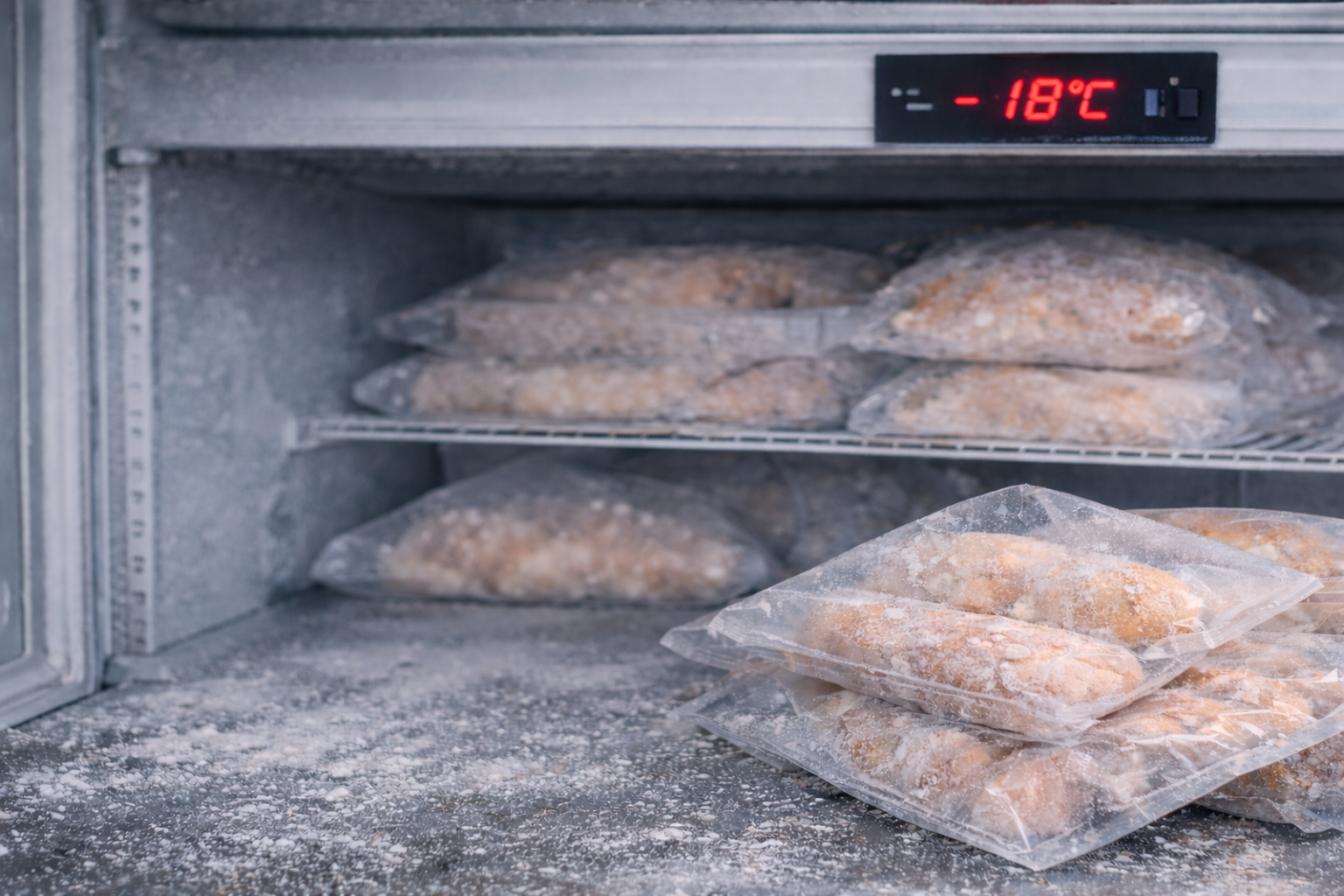
In the hospitality, catering, and food distribution sectors, bread is not just an accompaniment: it is part of the experience that an establishment offers to its customers. Knowing how to store bread in the freezer correctly makes the difference between serving bread that surprises and one that disappoints. At OKIN, we have been manufacturing high-quality frozen par-baked bread for hotels, restaurants, caterers, and supermarkets for more than 30 years. Product preservation is one of the pillars on which this quality rests at the final point of consumption. Therefore, in this guide, we share everything you need to know to properly manage frozen bread in your establishment.
Why frozen bread preservation is so important in the B2B sector
When working with significant volumes of bread—whether in a 200-room hotel, a restaurant with a daily menu, or a supermarket purchasing center—frozen stock management has a direct impact on three key areas:
-
Final product quality: poor preservation deteriorates the crust, crumb, and flavor, regardless of how good the original bread was.
-
Waste control: poorly preserved bread generates economic losses that can be significant in large operations.
-
Food safety: HACCP protocols and food regulations demand specific storage conditions that must be met to avoid health risks.
Optimal temperature for storing frozen bread
Temperature is the most critical factor in frozen bread preservation. To maintain all the organoleptic properties of the product—aroma, texture, volume, flavor—the freezer temperature must be kept stable between -18 °C and -22 °C. Above -18 °C, the cold chain begins to be compromised. In professional environments, we recommend:
-
Installing an approved continuous temperature recording system (datalogger) to comply with traceability requirements.
-
Checking the equipment temperature at the beginning of each shift, especially in summer months when frequent freezer openings can raise it.
-
Keeping the freezer away from heat sources (ovens, griddles, dishwashers).
-
Avoiding overloading it: an excessively full freezer hinders cold air circulation and generates hot spots.
⚠ Temperature fluctuations are particularly harmful. Bread that has partially thawed and is refrozen loses its structure and generates ice crystals that break the crumb. This is one of the most frequent mistakes in professional kitchens.
How to store frozen bread correctly: the 6 key points
1. Reception and verification of the cold chain
The preservation process begins before the product even enters your freezer. Upon receiving merchandise, verify that the frozen bread arrives at the correct temperature (≤ -18 °C). If the order arrives with signs of partial thawing—moisture on the packaging, deformed pieces, or pieces stuck together—notify the supplier and do not add it to stock without evaluating the actual condition of the product.
2. FIFO organization in the freezer
The FIFO principle (First In, First Out: the first thing in is the first thing out) is fundamental in managing any frozen storage. To apply it to bread:
-
Always place new stock at the back and move previous stock to the front.
-
Label each box with the entry date if it is not already labeled with a clearly visible best-before date.
-
Perform rolling inventories to detect products close to expiration and plan their use in advance.
3. Packaging conditions during storage
Quality frozen par-baked bread arrives in packaging designed to protect it during transport and storage. To maintain this protection:
-
Keep the bread in its original packaging until the moment of baking.
-
If you open a box due to stock needs but do not consume it entirely, seal the remaining pieces well in a freezer-safe bag, removing as much air as possible.
-
Avoid exposing the bread directly to the freezer environment: surface dehydration (freezer burn) spoils the crust and generates bitter flavors after baking.
4. Separation and organization by references
In establishments with several bread references—baguettes, ciabattas, sandwich loaves, individual rolls for hospitality—it is advisable to organize the freezer into differentiated zones. This speeds up the kitchen team's work, prevents service errors, and facilitates stock control. A good practice is to keep only one or two days' worth of stock in the service freezer (more accessible) and manage the larger volume of stock in a backup freezer.
5. How long does frozen bread last? Storage times according to product type
This is one of the most frequent questions among our clients: how long does frozen bread last without losing quality? The answer depends on two factors: storage temperature and product type. As a general guideline, frozen par-baked bread stored at -18 °C has a shelf life of between 6 and 12 months, although some specific references can extend up to 18 months. Always check the best-before date indicated on each product's packaging. To guide you in managing your stock, these are the usual ranges according to format:
-
Large format breads and baguettes (ciabattas, loaves, baguettes): up to 9–12 months at -18 °C.
-
Individual breads and small pieces for hospitality (rolls, bread pastries, breadsticks): up to 6–9 months at -18 °C.
-
Specialty breads with added ingredients (seeds, grains, olives): up to 6 months at -18 °C, as the incorporated ingredients can degrade sooner than the dough.
How long does bread last in the freezer once the packaging is opened? If you have opened the box but have not consumed all the pieces, the time is significantly shortened. Bread correctly resealed in an airtight bag holds up well for an additional 4 to 6 weeks, although it is ideal to consume it as soon as possible to take advantage of all its qualities. An important nuance: even if the product remains safe for consumption within its best-before date, the longer it remains in the freezer, the more its organoleptic qualities degrade. The aroma loses intensity, the crumb can lose fluffiness, and the crust may show freezer burn. Therefore, stock rotation is not just a matter of economic management, but directly of quality on the plate.
6. Cooling equipment maintenance
Well-maintained cooling equipment is the foundation of good preservation. Establish a maintenance protocol that includes:
-
Periodic defrosting and cleaning (normally every 1–3 months depending on use).
-
Door gasket review: a gasket in poor condition causes hot air entry and increases energy consumption.
-
Condenser cleaning: accumulated dust reduces equipment efficiency.
-
Annual review by an approved refrigeration technician.
From freezer to oven: the last step you cannot neglect
Good preservation can be ruined in the final step if baking is not done correctly:
-
Always bake the bread directly from the freezer, without prior thawing, unless expressly indicated otherwise by the manufacturer.
-
Respect the baking times and temperatures indicated for each reference. Baking at too high a temperature will accelerate exterior coloring without cooking the interior properly.
-
If you use a convection oven, adjust the temperature according to specifications: they usually require slightly lower temperatures than traditional ovens.
-
Never return already baked bread to the freezer.
Why Okin bread facilitates optimal preservation
At OKIN, preservation quality begins in the production process. Our CleanLabel philosophy—without additives or preservatives—demands an exhaustive control of the production process to ensure that the product reaches the customer's freezer in perfect condition:
-
Controlled par-baking process: baking is stopped at the exact point so that the bread completes its process in the customer's oven without losing structure.
-
Immediate freezing after par-baking: preserves freshness and prevents product oxidation.
-
Packaging designed for the professional sector: optimized for efficient storage in industrial cold rooms.
Conclusion: good preservation is an investment in quality
Knowing how to store bread in the freezer professionally is an essential part of quality control for any hospitality, catering, or food distribution establishment. A stable temperature, rigorous FIFO management, correct packaging, and proper maintenance of the cooling equipment are the pillars of an uninterrupted cold chain. At OKIN, we provide you not only with quality frozen par-baked bread, but also with the knowledge and advice so that this bread reaches your customers' plates just as we conceived it: with a crispy crust, a fluffy crumb, and the unmistakable aroma of freshly baked bread.