08.09.2026
Pre-baked frozen bread vs. fresh bread: differences for the HORECA sector
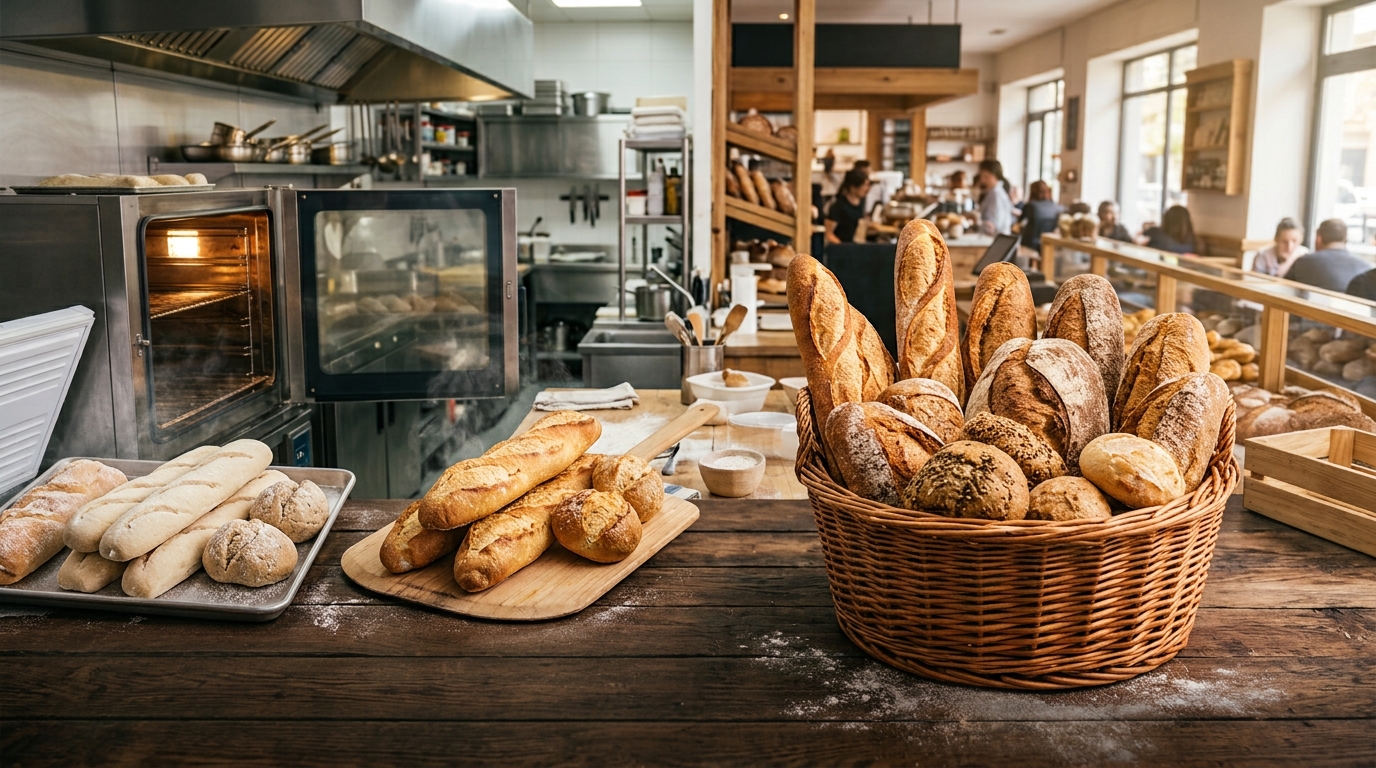
In hospitality, there is no "best" bread in the abstract: the choice between pre-baked frozen bread and fresh bread depends on the type of service, turnover, and logistics of each business. Pre-baked frozen bread offers predictability and less waste, while fresh bread offers immediacy without oven management. This guide compares both options to help you decide which fits your operation.
What is meant by fresh bread
Fresh bread is bread that is fully made and baked before reaching the consumer. In a HORECA business it usually arrives in two ways: produced in an in-house bakery, or bought already baked from a bakery or distributor with daily delivery.
Its main characteristic is that it is ready to serve without any additional process. In exchange, it has a short shelf life (usually hours) and depends on frequent deliveries or constant in-house production. Its quality depends on the moment of consumption: it reaches its optimal point shortly after baking and degrades quickly.
What is meant by pre-baked frozen bread
Pre-baked frozen bread is partially baked, frozen to stop the process, and finished baking on-site right before serving. By baking the piece on-site, the result is freshly made bread on demand, with a crispy crust and soft crumb, without needing a full bakery.
This format allows baking only what will be consumed in each time slot. Specialized manufacturers like OKIN develop ranges designed for the HORECA channel, with different formats and bread styles.
Differences in shelf life
Shelf life is the most obvious difference between the two formats.
Fresh bread: shelf life of hours. Must be consumed the same day or, at most, kept for a short time with a noticeable loss of quality. Requires daily management of received stock.
Pre-baked frozen bread: keeps in the freezer for months while maintaining its properties. Only what is needed is taken out of the freezer and baked on the spot.
This difference has a direct impact on purchase planning: with frozen product, purchases are made in batches and a permanent reserve is available; with fresh bread, you depend on delivery and getting the daily forecast right.
Differences in service
In service, each option changes how the kitchen or counter operates.
Fresh bread requires no oven or baking time: it arrives ready and is plated directly. Its weak point is the lack of flexibility: if there's a surplus, it's wasted; if there's a shortage, there's no room to react until the next delivery.
Pre-baked frozen bread requires an oven and a few minutes of baking, but allows freshly baked bread to be served at any time of day, even during hours when no supplier delivers. This ability to bake on demand is especially useful for long services or irregular peaks.
Stock control and waste
Waste is one of the hardest cost factors to control with fresh bread, since unsold pieces at the end of the day are usually thrown away. Bread is also one of the products with the greatest weight in food loss and waste according to the FAO, so adjusting production to actual consumption also has a sustainability component.
With pre-baked frozen bread, stock remains stable in the freezer and only what is baked becomes a finished product. This reduces waste to what is actually over-baked in each time slot, rather than the entire daily order.
Fresh bread has a shelf life of just a few hours, requires no oven for on-site preparation, its availability depends on delivery or daily production, carries a high risk of waste due to daily leftovers, requires daily purchasing, and needs less cold storage space. Pre-baked frozen bread, on the other hand, keeps for months when frozen, requires an oven and brief baking before consumption, is available on demand at any hour, has a low risk of waste since only what's needed is baked, allows batch purchasing with reserve stock, and needs freezer space for storage.
Perceived quality
In terms of perceived quality, well-made fresh bread from a bakery, consumed at its optimal point, is a hard benchmark to beat. The problem is sustaining that optimal point throughout the service: as the hours pass, fresh bread loses texture and aroma.
Pre-baked frozen bread, being baked on the spot, consistently offers a freshly made piece throughout the day. The key lies in the raw materials and formulation: bread with clean labeling, made under Clean Label criteria without additives or preservatives, brings the result much closer to that of artisan bread. The end customer's perception tends to value freshly baked bread in front of them more than fresh bread that has been sitting in the basket for hours.
Operating costs
Comparing costs requires looking beyond the price per unit.
Fresh bread: lower investment in equipment (doesn't always need an oven), but high cost due to waste, dependence on deliveries, and sensitivity to stock shortages.
Pre-baked frozen bread: requires an oven and a freezer, plus energy consumption for baking, but reduces waste, stabilizes supply, and adjusts spending to actual consumption.
The balance depends on the volume and regularity of each business. In establishments with variable demand, the savings from reduced waste usually offset the initial investment in equipment.
When to choose each option
It's not about ruling out one option, but assigning it to the right context:
Fresh bread fits when there's an in-house bakery with continuous production, or a reliable local supplier with frequent delivery, and a high, predictable turnover that consumes almost the entire order each day.
Pre-baked frozen bread fits when demand is irregular or hard to predict, when there are long services or hours without delivery, when the goal is to reduce waste, or when you want to offer a variety of breads without maintaining a bakery.
Many businesses opt for a combination: fresh bread for the most predictable time slots and pre-baked frozen bread to cover peaks, extended hours, and variety. The decision is also tied to choosing the right bread supplier, which determines the quality and consistency of supply.
Frequently asked questions
Is pre-baked frozen bread lower quality than fresh bread?
Not necessarily. Since it's baked on-site right before serving, it offers freshly made bread throughout the day. Quality depends on the formulation and raw materials: bread with clean labeling and no additives can achieve a result very close to artisan bread.
How long does each type of bread last?
Fresh bread has a shelf life of hours and must be consumed the same day. Pre-baked frozen bread keeps for months in the freezer, and only the necessary amount is baked each time.
Does pre-baked frozen bread help reduce waste?
Yes. Since only what will be consumed is baked, stock remains stable in the freezer and waste is limited to what's over-baked, rather than the entire daily order.
Do I need special equipment for pre-baked frozen bread?
You need an oven for final baking and a freezer for storage. In exchange, you don't need a full bakery or dependence on daily deliveries.
Can I combine both types of bread in my business?
Yes, it's a common practice. Many establishments use fresh bread for predictable consumption time slots and pre-baked frozen bread to cover peaks, hours without delivery, and product variety.
About OKIN
OKIN is the pre-baked frozen bread brand of Artadi Alimentación, S.L., a family business based in Zumaia (Gipuzkoa). Its catalog is aimed at the HORECA channel and food distribution, with bread made under Clean Label criteria, without additives or preservatives, in formats designed for hospitality, food service, and distribution.
If you're considering how to cover your bread service with consistency and flexibility, you can explore the product families at "choose your bread.